If all goes well, we’re off tomorrow afternoon, bound for Savusavu in Fiji, departing from Tauranga, New Zealand where we’ve spent the last five wonderful months. It’ll be sad to leave NZ but it’s getting cold and the tropics are calling.
The passage should take us about 9 or 10 days. We’re planning to stop at Minerva Reef on the way to avoid some stronger winds due in Fiji about the time we’d arrive there without the stop in Minerva. We’ll update our blog when we get set up in Savusavu.
Bula Vanaka,
Rich and Cyndi
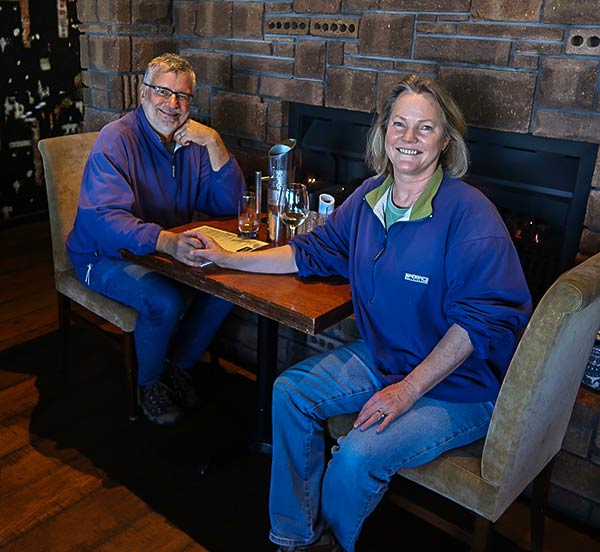
Enjoying our traditional send-off meal by the fireplace at Phil’s Place.
–An Introduction to Western Fiji
–Things We Learned About the West Side of Fiji
–The Cruiser’s Traingle
–The Mamanucas (an overview)
–The Yasawas (an overview)
Someday I’ll add a page showing all the anchorages, but for now I hope this is a pretty good overview for anyone traveling to Western Fiji. A couple of months ago we added information to the Eastern Fiji section—in fact that part is pretty much wrapped up (well, except for blog posts I’ve yet to write; but I’m working on that). Yet to come will be Kadavu, maybe next season. Hope this is helpful. –Cyndi
“It’s only a date. He didn’t ask you to marry him yet!” Cyndi West, 2018
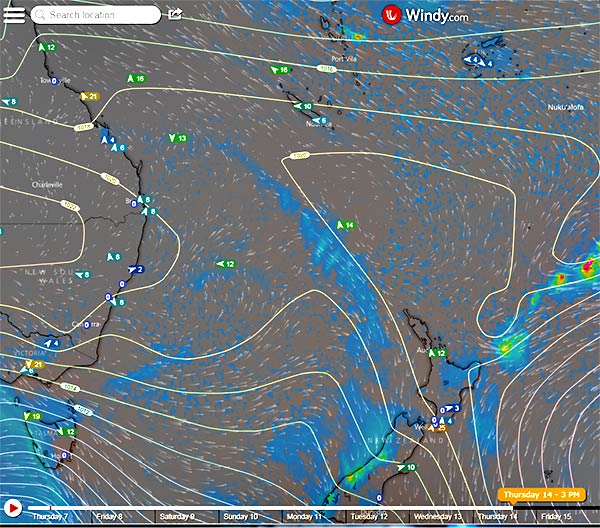
Yep, we have a date, but it’s a long way off and things change. Maybe this window won’t be the one? Maybe a low will appear and break this affair up? Maybe the South Pacific Convergence Zone will kick up? A lot can happen to a weather window, but we think we might see a keeper.
A possible weather window as seen on Windy.com.
The possibility is real enough that we emailed Bob McDavitt, our weather router, to engage his services for this passage to Savusavu, Fiji.
One of our tasks this season in New Zealand was to replace our 24-year-old liferaft with a new one. They’re supposed to be repacked and re-certified every one to three years, depending on their age, but ours hadn’t been done since we left Los Angeles six years ago. Ours was too old to re-certify.
When we removed our old liferaft, I had Cyndi try to deploy it as if we were in an emergency and she was the only person left to launch the raft. She did it, but it was really hard, and we were tied up in a calm berth. These rafts are very, very heavy. I think I falsely assumed that adrenaline would kick in if it were a real emergency, but can that be counted on? What if the boat was pitching and rolling in ten meter seas? Could Cyndi launch the very heavy raft? Could I? Maybe not.
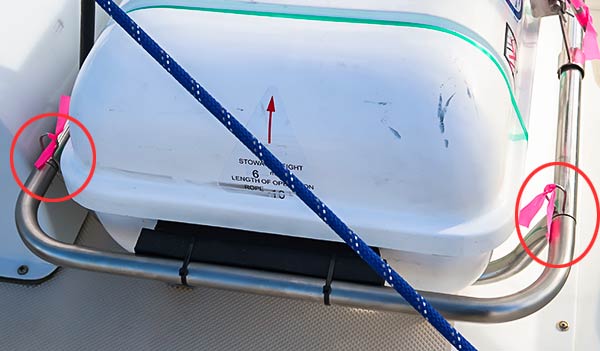
With this in mind, we made some modifications when we remounted the new raft. We cut the stainless steel frame and pined it together with ‘R’ clips. See the picture below.
‘R’ clips added to the liferaft frame to make removal easier.
By removing the clips, the frame comes apart and the raft doesn’t need to be lifted over the frame – only slid out.
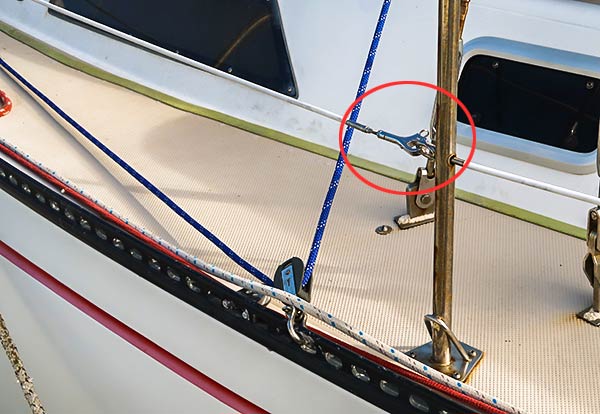
We also added pelican hooks in the bottom lifelines on both sides of the boat so that the raft doesn’t need to be lifted over the lifelines. See the below picture.
Pelican hooks added in lower lifelines to make liferaft deployment easier.
All pins that must be pulled to deploy the raft are tagged with bright red tape to make it easier to find in a flat-out emergency situation. I feel good about the changes we made and a little foolish thinking that adrenaline alone would overcome rough conditions and the weight of the raft.
After we replaced our raft, we deployed our old one in a nearby grassy area. Here’s a post about how that went. Hint: not all that well! -Rich