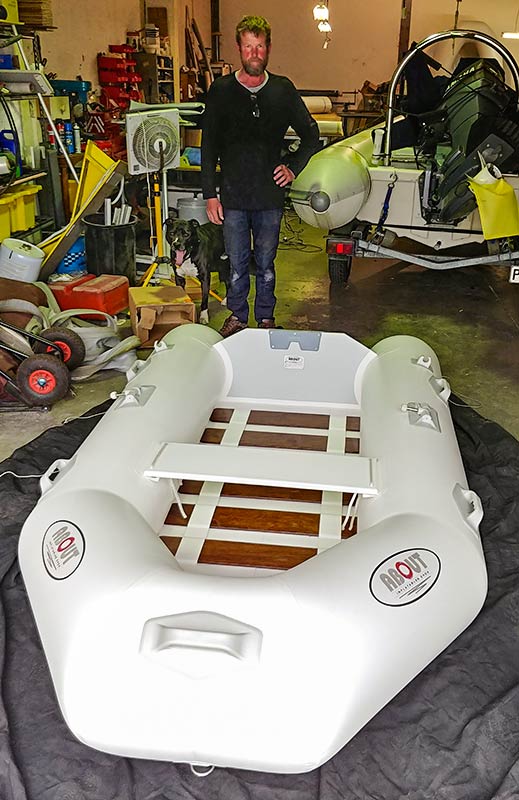
Our new “About Inflatables” dinghy with her creator standing behind her (the guy, not the dog).
We got our new inflatable dinghy today after so much research and indecision about what to buy. Our last one, a Maxxon we bought in New Zealand and made in China, was a disaster. It only lasted a season. We finally decided to by one from About Inflatables here in Christchurch. They are actually made just a few miles from our boat. While we haven’t used it yet, we are so impressed with what we see. We hope to have it for many years.
Godzilla? Oh yea, that’s what we’re naming her just because Cyndi has always wanted a boat with that name. -Rich
Many of our fellow cruisers are not in agreement with us on our wariness about sharks, something I was vividly reminded of as I read over the blog entries from our Pacific crossing in 2012. In one post I remarked that I felt like I’d entered some sort of alternate universe where sharks, instead of something to be feared, were something to be sought out. People were treating sighting them (and I mean while snorkeling and diving) with the same excitement one would have over spotting a sea turtle or dolphin! Since that first season, things have changed, well, not at all.
During that 2012 season I was charged by a large blacktip reef shark while snorkeling at Anse Amyot, and while it veered off at the last second when I screamed loudly, it was definitely too close for comfort. Yet when I recounted the event during that evening’s group dinner ashore (a group which included a marine biologist), I found my story being dismissed. Rich, who witnessed the event and knows a thing or two about marine biology himself, backed me up, but people still seemed to scoff as though I were imagining the incident. Rich and I knew the aggressive behavior was unusual and theorized that maybe the locals pounding rebar into the reef to build a fish trap had made the sharks edgy. (In retrospect, those fish traps were a really terrible thing.)
In any case, we both treat sharks with a great deal of respect. We don’t freak out if we see one, but we do stay still and keep an eye on the shark as it swims by. If it swims off into the distance, fine, but if it turns around and comes back to get another look at us; we get out of the water. We’re definitely on the cautious end of the spectrum.
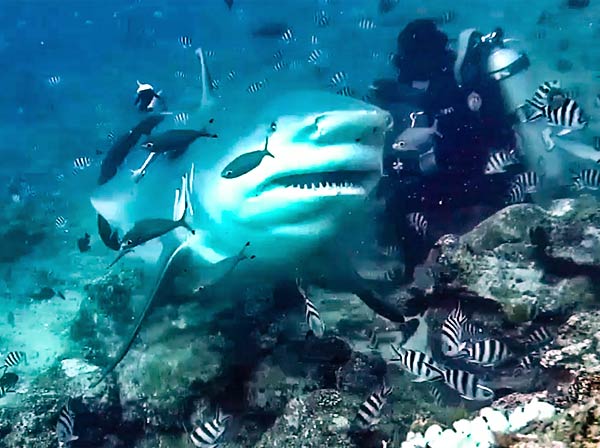
Lest anyone think we’re just paranoid or have a phobia, I think we’ve earned our shark merit badges by doing the famous bull shark dive in Beqa, with extra credit because we both loved the dive, and extra, extra credit for hoping a tiger shark would show up (alas, no tiger shark, but we did have a lot of bull sharks, lemon sharks, and a few others). It’s not that we had any less fear of the sharks than usual, but we trusted the guides and felt safe in the environment where the shark encounter took place. It was a thrilling dive, and seeing those huge, magnificent sharks was a peak life experience. But the key factor there was seeing them in a controlled environment. We would never, ever, want to run into one of these sharks while in the water by ourselves!
Our dive with bull sharks in Fiji was amazing!
When discussing shark attacks with other cruisers, some people cling to the belief that they’re merely curious and may just want to taste you, certain to spit you out once they realize you’re not their preferred food. Even if that were true, it’s not much consolation when your arm, leg or half your gut is torn out because the shark just wanted to see what you taste like. As for the belief that they only bite humans by mistake and spit them out immediately, I have to remind people that they often bite and spit out sea lions, leaving them to bleed out before finishing them off. Anyone who’s seen the teeth on a sea lion can understand why the shark would attack this way; and why biting and swimming off doesn’t indicate that the shark doesn’t like the way you taste. It’s likely just waiting until you’re too weak to bite back (like a sea lion) or poke them in the eyes and punch them (like a human).
And while sharks may not prefer humans as food, they do sometimes eat them. Any apex predator who gets hungry enough will make do in a pinch, as evidenced by all the human beings we witnessed eating airplane food on our last flight. (We, too, ate the crappy sandwiches. I wish the Cheesecake Factory would consider starting an airline.)
I think one of the reasons people are so complacent about sharks is that attacks on cruisers are very rare, although they do sometimes happen. After having one discussion with another cruiser who insisted sharks aren’t really dangerous, we realized we knew of three attacks that happened in areas we were cruising at the time. One was in Tonga (the girl was rushed to a hospital but her injuries weren’t very bad), one was a fatal attack on a swimmer off the coast of New Zealand, and the third was a fatal attack off a small island in New Caledonia in 2015.
That third incident was really chilling for reasons I’ll soon explain, but I’ll first say that particular 2015 season was part of what brought us to the conclusion we’ve come to about sharks. In our experience, we’ve noticed that the same species of shark can be far more dangerous in some areas than others. This became apparent during that particular visit to New Caledonia. It was actually our second time there, but our first visit where we actually cruised the waters around the area.
We had a plan for our first outing into Noumea’s huge lagoon, including trip to Baie de Prony on the main island of Grand Terre, then a day-sail down to the beautiful island of Ile des Pins (New Caledonia’s undisputed crown jewel) where we’d spend a few days before traveling north through a line of islands back to Grand Terre. Below, a map of our route and stops during that particular trip:
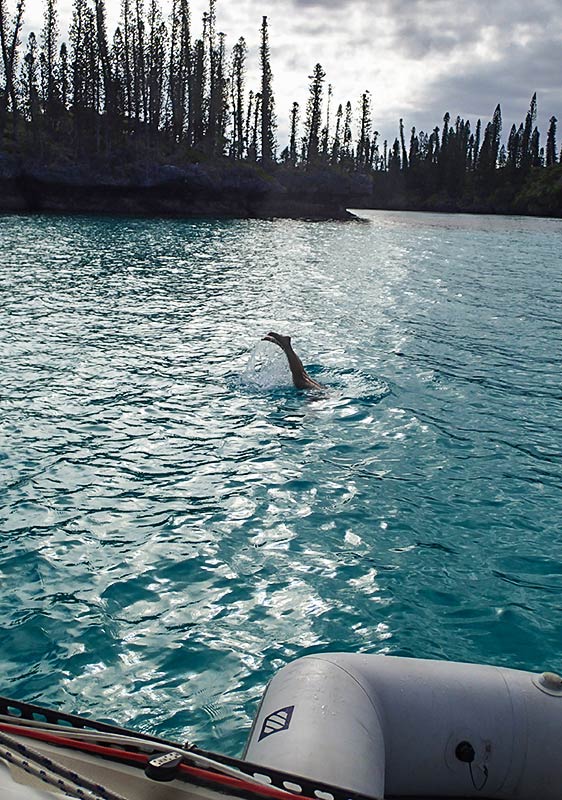
The trip went as planned and after a stop at Baie de Prony, we made the day-long trip down to lovely Baie d’Oro off the Meridian Resort, not often visited by cruisers as it requires very settled weather to go to that particular anchorage. We hadn’t yet been swimming; so I gleefully dove into the clear blue water in this fantastic setting and took a swim!
Baie d’Oro’s beautiful setting.Swimming in Baie d’Oro.
At lunchtime the following afternoon, we got our first clue that there was something unusual about New Caledonia. I was making chicken and tossing scraps to the gulls as I usually do. Rich happened to be in the cockpit and suddenly exclaimed, “Shark, a big one!” I went to look and saw a large blacktip reef shark circling our boat! The intended scrap recipient, the gull, squawked at the shark but didn’t fight it for the food. In all our years of cruising, we’ve had many fish and birds show up to enjoy our food scraps, but never a shark as they normally prefer reefs to the sandy bottoms where we anchor.
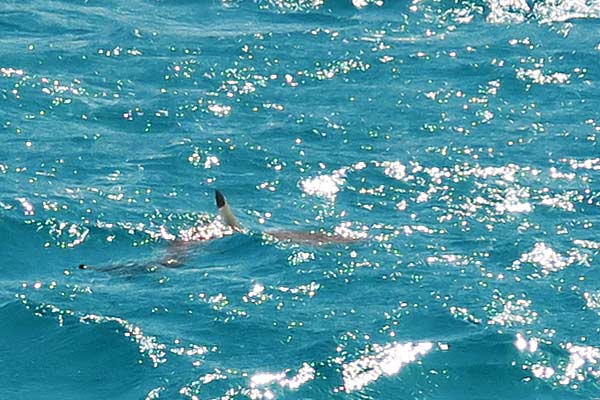
A shark swimming by our boat at Baie d’Oro.
As the day went on, we spotted three more sharks, including a large one near that bottom that ominously looked like something other than a blacktip. There would be no more swimming for me in Baie d’Oro. The next day, we went to another area best suited to settled weather, Baie de Gadji. It was even more beautiful than Baie d’Oro, but we opted not to swim there, instead enjoying motoring around its rock islets in our dinghy.
Baie de Gadji
After Gadji, we headed to our final destination on Ile des Pins: Baie de Kuto. Motoring near the coast, the water was quite shallow and very clear, giving us a good view of an unnervingly large, dark shark lurking below. Again, it was odd to see a shark hanging out in clear water over a sand bottom especially in the light of day as they generally prefer reefs.
Anchored in Kuto Bay, we explored the island and waited for the next calm weather period in which to travel through a series of islands back to Grand Terre. We were especially excited to snorkel at what sounded like a beautiful spot, Kouare Island. Chatting with some new cruiser friends about our plan, we were warned that someone had just been killed by a shark there and perhaps we should look into it. It was unnerving news, but at that point we didn’t have access to the internet to investigate the incident.
As luck would have it, we took a pirogue (dugout canoe with a sail) tour the following day and among our fellow passengers were too off-duty gendarmes (French police). If anyone should know about a recent shark attack, it would surely be gendarmes! And so we asked, and they pondered or question for a moment saying well, it wasn’t recent, but a man was attacked while snorkeling by a whale carcass in Prony. We figured this could explain how someone might have gotten killed, and while not sure what to think overall at this point, we decided to go through with our plan to stop and snorkel at Kouare Island.
Kouare proved to be a beautiful spot, and after arriving late in the afternoon, we planned to snorkel the next day.
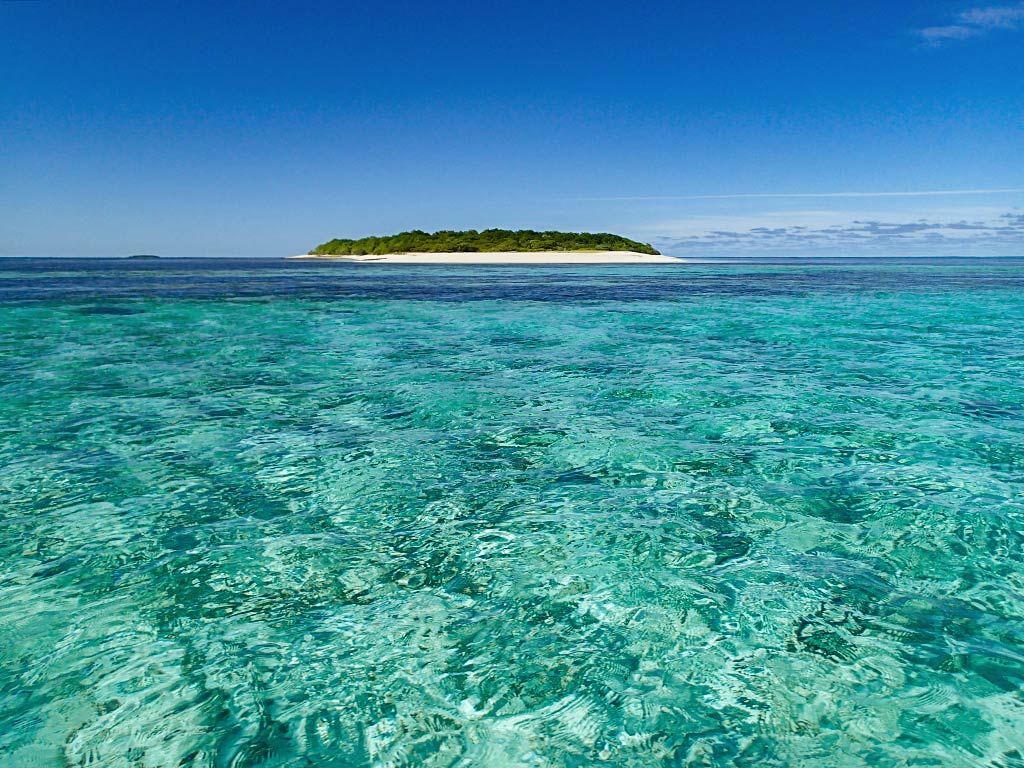
Beautiful Kouare Island
As we enjoyed the next morning’s breakfast in the cockpit, I threw scraps to a couple of fish, who thrashed about while going after the food. We looked into the clear water below our boat and hovering close to the bottom appeared a large, dark, and heavyset shark, likely a bull shark. Rich remarked, “That’s a bad shark.” It had come by to see what the fish were so excited about, then left, but it was unnerving.
That afternoon, we decided to go ahead and do our snorkeling but stayed very close to the island and the shallow water above the reef. It was nice snorkeling, and after a time we felt safe enough to venture out and snorkel a large bommie covered with coral and tropical fish.
Snorkeling above the reef at Kouare
It wasn’t long before Rich swam back to the dinghy and nervous about being in the water by myself, I followed. Once in the dinghy he told me that he’d been noticing movement in the distance and had the feeling we were being watched. He felt it was time to get out of the water. Yep, time to get out of the water and not go back in, at least not here.
We soon headed north to other small islands, arriving at our final spot late in the afternoon. As we dropped our anchor and set it, a curious visitor came to check us out. Not surprisingly, it was a shark, another blacktip reef shark. Looked like we wouldn’t be swimming at Mato, either.
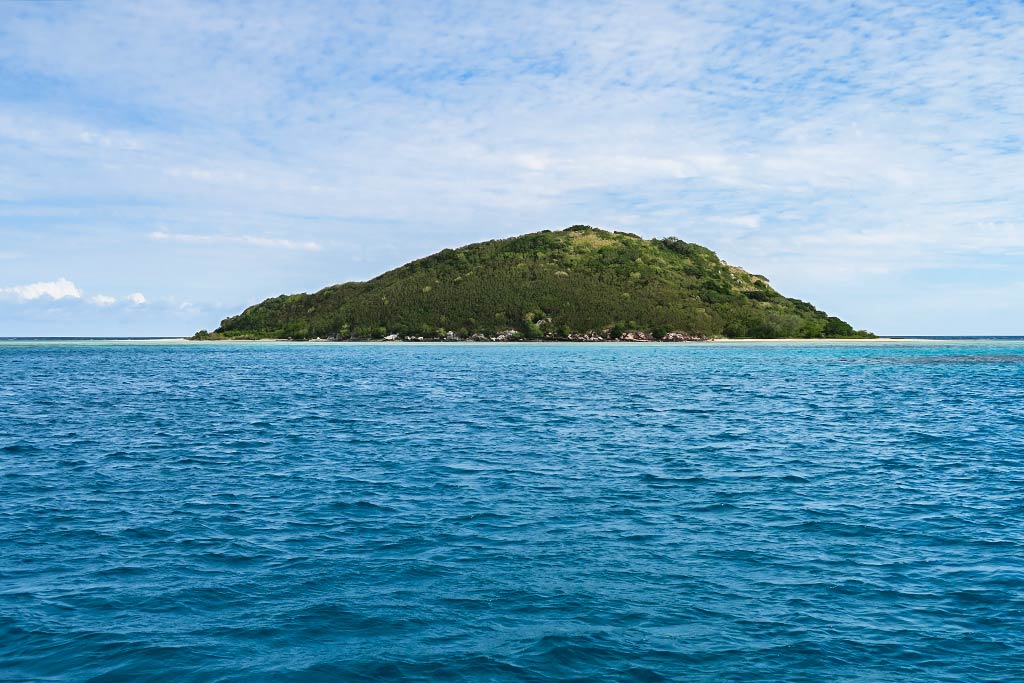
Our anchorage at Mato Island.
At least we now had internet access, and I was curious to check out the shark-attack story of the snorkeler near the whale carcass. Only there was no whale carcass and shark attack in Prony. There was, however, a fatal shark attack on a snorkeler at Kouare Island not long before we were there. The attack was not a “let me taste you and see if you’re interesting” sort of attack, but a vicious, ripping-the-body-apart kind of attack, making me think the shark might have been defending its territory. A man had been snorkeling with a group off a tour boat, a bit unusual in that tour boats don’t generally go to Kouare. There were a few people in the water, but for some reason the shark singled him out and made its move. The people with him got him out of the water, and he received quick and expert medical aid, but he was too badly injured to survive.
So, it seems our cruising friend was right and the gendarmes remarkably uninformed (although I’ve since noticed shark incidents heavily-touristed areas are kept somewhat on the downlow). The incident took place only three weeks before we were there, snorkeling in the same spot. As you can imagine, it was chilling to know that we may have encountered that very shark as tossed food into the water for the fish. Rich’s instinct about it was spot on: That was a bad shark.
Since that time, there have been more incidents in New Caledonia. On that same visit in 2015, we made a road trip north to an area called Poe Beach. With its shallow, clear blue water, it looked like a safe area to wade and must have seemed so to the woman who ventured in with her dog before she was fatally attacked the following year. Three kite surfers were also attacked in New Cal that year, one of them fatally.
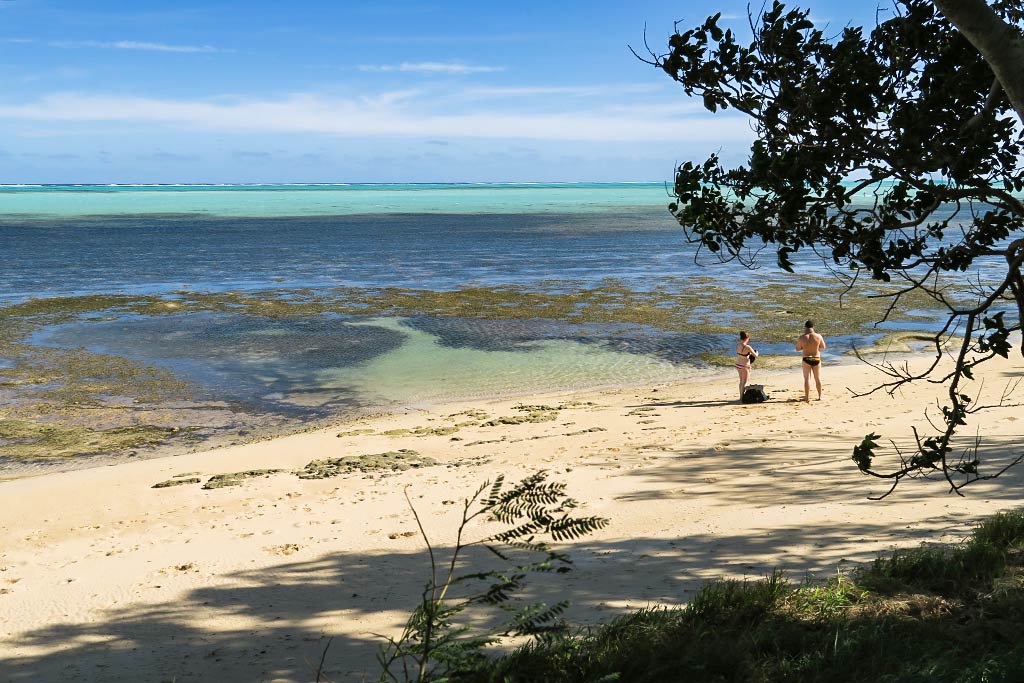
Poe Beach in New Caledonia. It looks safe. It isn’t.
Not surprisingly, we no longer swim casually in New Caledonia, but we have ventured into the water to snorkel at an island called Ua. There are so many people who snorkel there, including a constant stream of tour boats, that we felt safe going in, and it was a pretty fantastic snorkeling site.
Meanwhile, I don’t know the statistics for 2017/18, but I do know there have been two attacks in New Caledonia in 2019. One happened to a fisherman wading on a reef, and the second attack happened to a boy swimming off a boat anchored in Baie de l’Orphelinat (Noumea’s main anchoring and mooring area and much-frequented by international cruisers). The fisherman’s attack was fatal, and it’s miraculous the second attack wasn’t as the child’s injuries were extensive, something most people wouldn’t survive. His father jumped in and rescued him, saving his life.
After I heard about the attack on the boy, I was curious about the details such as the name of the boat, exactly where the attack happened, and was it one of the cruising community? Frustratingly, there was almost no information to be found. I was only able to determine the boy had been put into an induced coma. After that, the news was pretty much silent on this subject for months except for one tidbit: the offending shark had been tracked down and destroyed.
What? That area is huge and busy, filled with boats on moorings, at anchor and in marinas and not a place a shark would normally hang out. I’m sure that shark was miles away, back out in the lagoon with the thousands of other such sharks, in the commotion that must have ensued after the attack. How would you hunt down that particular shark, and how would you know it was the culprit—did they cut it open and find pieces of the kid? It was a long time before I could find out any more information.
Months later, I came across a very brief article about the boy who was attacked and that he had survived. According to witnesses, he had been attacked by a bull shark, but there’s some doubt about that as two tiger sharks had been spotted in the area the day before. The conclusion I take from this: the shark had obviously not been identified and destroyed as the previous article had stated—they aren’t even sure what type of shark attacked him! I thought newspapers lying about shark attack incidents (so as not to scare off tourists) only happened in movies, but this case seemed like it could have been pulled from the Jaws script.
This past season (June – October, 2019) brought the most shark terror we’ve ever experienced. We rented a condo, complete with cable TV, and came across upon National Geographic’s Shark Fest. After watching a few shows about attack swarms in areas we’re familiar with, I wondered why attacks are spiking. After some research I think they aren’t really. There are always attacks in certain areas of the world, and if one chooses the summer months where there are a lot of people in the water, one can see elevated numbers of encounters and call it a “spike.” These attack swarm shows are much more entertaining than Law and Order reruns; so we saw a few of them.
In real life, while we were watching those shark shows and Law and Order reruns, Hawaii (the place where we rented the condo) was having a higher-than-usual number of shark encounters. What we observed: there would be a flurry of news for a day or two and they’d close the beach or swimming area, but then those signs would come down after a day or so, the incident soon forgotten. Not that I’m criticizing this as, after all, encounters regularly happen all over the state of Hawaii; it’s just part of the risk of swimming or surfing there.
I guess the moral of this story is much like “let the buyer beware.” Visitors should never assume they’ll hear about shark incidents as it doesn’t behoove tourist-dependent destinations to dwell on such things. Thus it pays to do some research. One nifty thing I’ve discovered are the yearly global shark attack maps on trackingsharks.com. It has maps that show the attack count in any given area you zoom in on and differentiates between the types of encounters, giving a brief description and links to key news articles.
As to types of encounters, Rich and I are most concerned with swimmers, snorkelers and divers unless they happen to be spearfishing. I’ve noticed shark-attack tracking sites put spearfishing encounters in the “provoked” category, and we would agree with that. It may sound callous, but spearfishing is risky, even reckless, behavior in areas known to have sharks. Not only are spearfishers in waters inhabited by large fish and thus sharks, but being speared causes fish to make the type of distressed movements which attracts sharks, not to mention adding fresh blood to the water. On top of that, spearfishers are competing with the sharks in their own territory, and of course a shark will defend its hard-won territory as many predators do.
For now, I’ve bookmarked trackingsharks and will refer to it when heading into new waters in Indonesia. We’ll continue to take general precautions such as not swimming near dusk or dawn, not swimming in murky water, not swimming in shark-infested waters, and not swimming where shark attacks have happened (thank you Vanuatu Rocket Guide for indicating a couple of very hazardous areas, still considered so by the locals we talked to).
One Note: We did hear about the incident that happened this year during one of bull shark dives in Fiji. A tiger shark showed up and bit the scuba tank of one of the observers who ended up with a laceration on his head. Yes, there is risk diving with those sharks, but the incident also proves the point I was making earlier in that the guides did their job, took control of the situation and got that shark off the guy. They were great, and that’s why we felt safe with them. It also looks apparent to us that the shark was initially attracted by the bright orange fins worn by one of the spectator divers. Note to self: Stay away from people with bright orange dive gear! Here’s the video on YouTube.
A Final Note: In spite of my close call being poo-pooed in Anse Amyot, it seems blacktip reef sharks can and do bite people. In one Shark Fest show we watched, a man was attacked by a blacktip reef shark while swimming off his boat in the Caribbean. He wasn’t killed, but the bite was nasty, a softball-sized chunk taken out of his leg. Whether or not he did anything to provoke the incident; it goes to show that blacktip reef sharks should not be dismissed as inconsequential.
Like this one, many shark attacks are survivable, but are they survivable if they happen at Minerva Reef, or some other very remote location without an ambulance service and a five star trauma center? Places like we cruise?–Cyndi
We’ve had a CO detector on Legacy for the past five years or so. It’s only gone off once in still air at a marina when our neighbor was running his generator and filling our boat with the deadly gas. They only last for a limited time and ours needed replacing recently. We bought a new one at a home store and immediately started getting alarms. Why?
Possible Causes
1. There really is CO in the boat.
2. The alarm is defective.
We assumed the latter and returned the detector for replacement. The new one did the same thing. Now we’re getting worried. I did some Googling and found that some units, particular cheap Chinese ones, will detect other gasses like fuel vapor, cooking gas or hydrogen from batteries. We ran the stove with the boat closed up and the reading was zero. We ran our diesel heater, no CO. We don’t smell fuel vapor, so we’re left with hydrogen.
Hydrogen comes from non-sealed lead-acid batteries when they are charged. As far as I know, if well ventilated into a substantial area, it’ll never get to explosive levels. (The alarm on the CO detector is an unwanted consequence of a poorly made detector and not designed to detect explosive levels of hydrogen gas.) We have metal parts in our battery compartment and they are not corroding so how bad can it be?
What to do?
1. Replace our batteries with sealed batteries, like AGM or even lithium ion batteries. We had new Lifeline AGM batteries when we left on this trip and they only lasted two years. It turns out that the fine print says they need to be charged to 100% every third charging cycle. That’s just not practical for a cruising boat. Here’s more about that.
Ironically,with our increased solar capacity (about 500 watts), we could probably meet the AGM full-charge-every-third-cycle requirement now. Still, our Trojan T-105 flooded batteries seem to be in great shape and I’d rather spend the cash on wine or some other important essential.
Lithium ion batteries are just too expensive for us at this point. We’d have to consider not only the high price of the batteries ($3000 to $8000 USD) but also the cost of modifying all charging sources so that they are suitable for charging these expensive batteries with their particular charging requirements.
2. Vent the battery compartment outside the boat. That sounds easy but it would involve sealing the batteries in some kind of compartment and running a vent line to some outside point that wouldn’t take in sea water. I’m not sure there’s such a point on our little submarine!
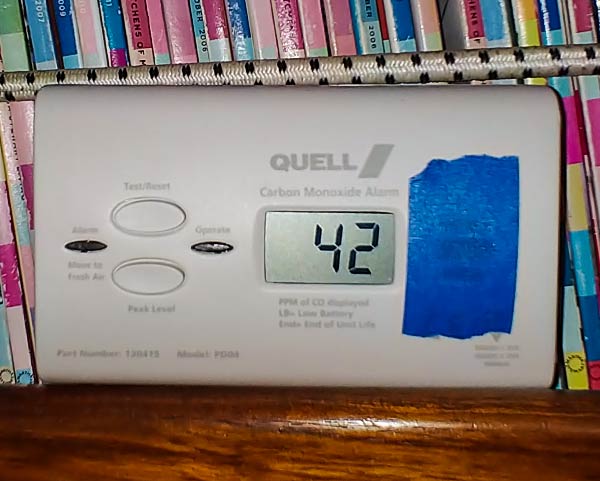
3. Get a new detector. I guess this is the best option, but I kind of like knowing about the hydrogen. Today, for example, it was reading 42 ppm. When I looked at our battery state monitor (BM-2) I see that the solar controllers are running at the bulk charge rate of 14.8 volts. This is great for the batteries periodically, even daily, but causes the out-gassing. I put the CO monitor in the cockpit to avoid the alarm. Having to do this daily will get old when the novelty wears off.
4. Ignore it. To do that, I guess I’d just leave a battery out of the monitor until I wanted a reading, like when a neighbor is running an engine or generator. This doesn’t help us if our diesel heater malfunctions while we’re sleeping. Maybe not the best option.
Truthfully, I really don’t know what we’ll do about this. After writing this, I’m thinking AGMs or a new monitor. We’ll see.
P.S. I added the blue tape to make the alarm quieter. Without the tape, it’s a suitable volume for a Olympic stadium, not a small boat.
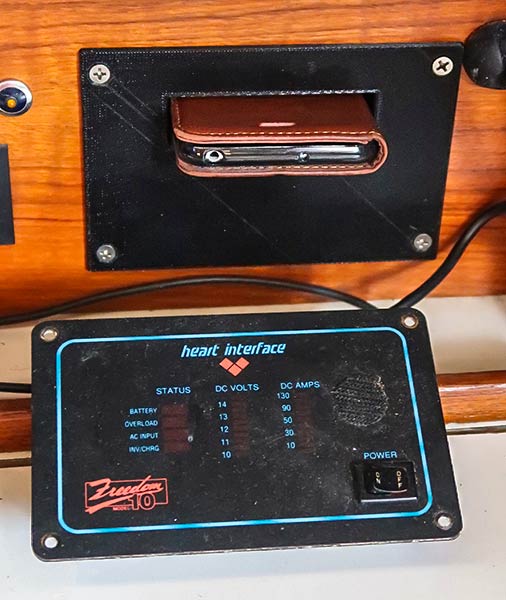
There was an old, unused piece of equipment in one of our instrument panels – a Heart Interface Inverter controller. Wouldn’t that be a great place to keep and charge my phone?
My new phone holder/charger with the unused piece of equipment removed and sitting below.
I just slide my phone, with the case, into the slot and it connects to the USB charger cable almost automatically.
I was thinking about the most important suggestions I’d give someone going offshore the first time and near the top of the list was to make a two day passage before setting off on a long voyage. We hadn’t done this when we headed from Los Angeles to Hawaii the first time and never realized how much skill it took, or at least a different skill set, to keep the boat moving when conditions weren’t ideal.
When day-sailing off the California coast it just wasn’t an issue. If the wind went light or on the nose, we’d flip on the engine. No problem. On our 2,250 mile trip to Hawaii, we wouldn’t have had the fuel to use that strategy. We learned “on the job” how to use the gib pole and how to trim the sails in light air. It would have been nice to have these techniques mastered before we set off.
Then I was wondering why this hasn’t been an issue for us since reaching the Marquesas. Now, if the wind goes light, we just motor. The reason we can do this now, is that our passages are relatively short at only seven or eight days and around 1,000 nautical miles. With our fuel capacity, we can do almost that distance under power. On one passage from Fiji to New Zealand, with no wind, we motored 800 miles. It was lovely, if a bit noisy.
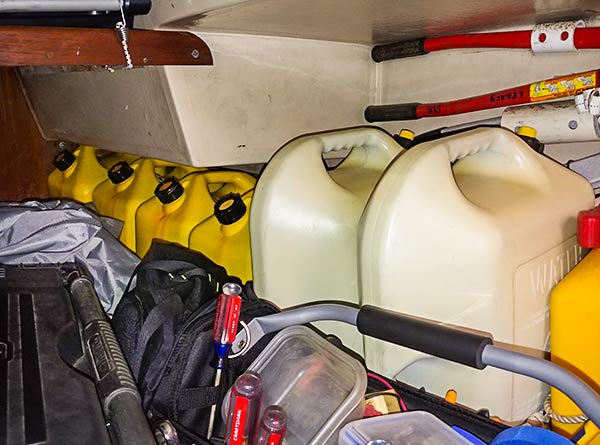
We have a 35 gallon (132 liter) main tank, a 20 gallon (75 liter) bladder tank and we carry six jugs of fuel in our aft quarter berth that hold 33 gallons (125 liters) making a total capacity of 88 gallons (333 liters). We also sometimes carry an additional jug in our cockpit that holds 7 gallons (26 liters). In ideal conditions, our engine burns about 0.5 gallons an hour and 5 knots. That’s a max range under power of 950 miles. In adverse conditions, we don’t do as well. If there’s a little wind helping, we do better.
We carry all this fuel below decks. Our walkways around the deck are narrow and Legacy has low freeboard, so there are some pretty violent waves that wash over our decks. I have fears that if our jugs are secured to the shrouds, a wave could take our rigging along with the jugs. I also don’t like the way jugs move the center of gravity higher with jugs on deck.
Six fuel jugs in our garage, ah, quarter berth. (See why we never have guests/crew?).
Adding the bladder tank under our port dinette seat was one of the best things we did on Legacy. We have a little electric transfer pump and valves to direct the fuel from the bladder tank to or from the main fuel tank (there’s no separate fill hose for the bladder tank). This means that if conditions are rough, we don’t need to be adding fuel from jugs out on deck.
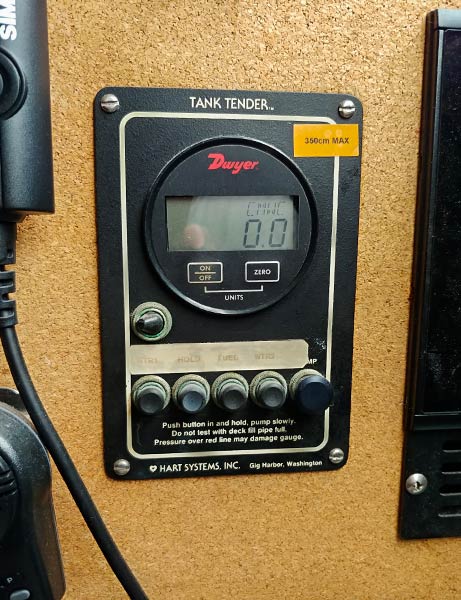
The Tank Tender, with the third gauge we’ve installed, this time digital. Still not very good.
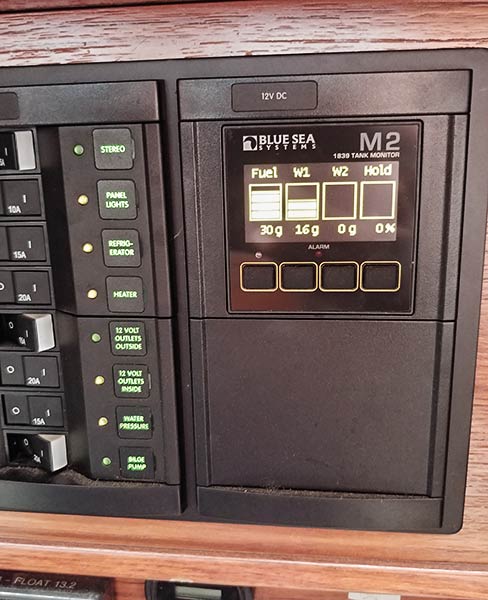
Keeping track of the fuel remaining on a passage has proved to be a challenge. A good gauge is essential and hard to find for boats. We had a Tank Tender and for a few years, it was spot-on accurate. We could tell how much fuel we had down the liter. Over pressurizing the gauge once due to a plugged air tube ruined that. We replaced the gauge and recalibrated but it was never the same. We installed Blue Sea’s gauge and ultrasonic sensors but they are total junk! We’re now using Blue Sea’s display unit but with an old fashioned, mechanical sensor. With all that, we’ve never had the kind of accuracy we had with our first Tank Tender.
The Blue Sea M2 tank gauge. Now we’re using an old fashioned mechanical sender for fuel.
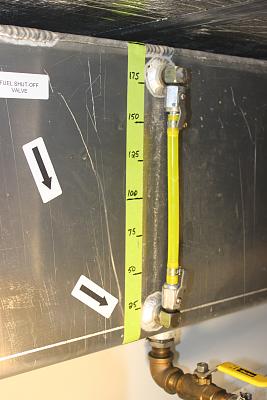
I’ve considered flow meters, but at the low flow rates of our small diesel engine, along with the additional complication of the fuel return line, this solution is expensive and I don’t think the results will be any better than what we have. Maybe a good, old fashi0ned sight glass would be better, but it would be hard to use on Legacy. Maybe a dip stick?
A sight tube posted on Trawlerforum by Great Laker.
So, to bring this perhaps pointless conversation back around, our suggestion if you’re heading offshore for the first time on a passage that’s significantly further than your fuel range is to learn to keep the boat moving, no matter the conditions (exception for rough conditions – then learn to heave to). If the passages are “short,” augment your fuel capacity so that you can motor. It would be lovely to drift along at two knots in light wind and calm seas, but we’ve not had that luxury since our Hawaii trips as we’ve always been racing a weather system that wants to catch us and hurt us! -Rich
Note from Cyndi: Before our first trip to Hawaii, we had a neighbor, a very experienced cruiser, who was all excited about going on a sailing outing with a “light air specialist.” He invited us along, but we had something else to do and didn’t take him up on the offer, not seeing why this was so exciting. We came to regret that decision as we found, during our trips to and from Hawaii, that light wind can be every bit as challenging as heavy weather, especially when it’s combined with swells that dump the air out of the sails.
What we learned on our own is being able to pole out the jib is invaluable on very long passages such as those we made to and from Hawaii. We once met a new cruiser in San Diego headed for Hawaii, and I insisted that he needed to invest in a pole for his head sail. He later wrote us and thanked us as it came in very handy on his crossing.
For all that insisting back then, we almost never use our pole on our crossings to and from New Zealand as we’re always racing a weather system and have to keep the speed at maximum warp drive (“More power, Scotty, more power! The lives of 2 crew members depend on it!”) -Cyndi