Pumice Fields (On the Passage to New Zealand)

November 27 – December 5, 2012

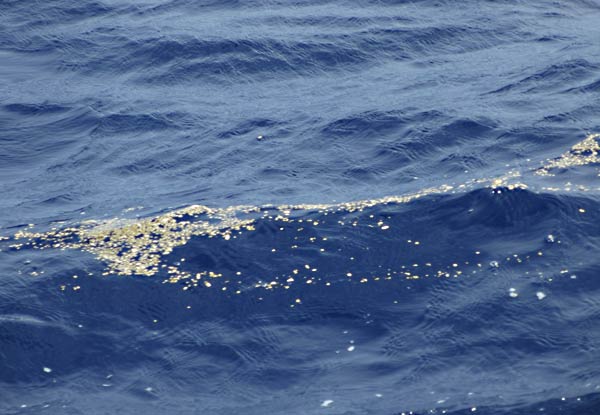
Weeks before leaving Tonga, we’d been hearing about the massive pumice field that we might have to traverse to get to New Zealand.  There’s an underwater volcano that’s spitting the stuff up in massive amounts and these lighter-than-water rocks float in what looks like endless, flat islands on the water’s surface.  Crossing them can be a problem.  They can plug engine water strainers and even damage the hull as they constantly sand away paint and fiberglass as you motor or sail through them.

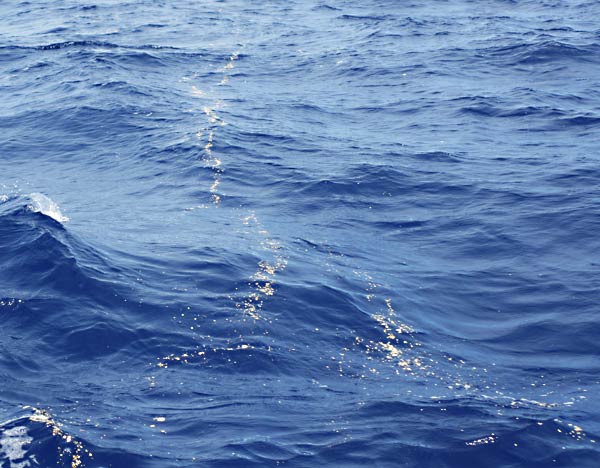
It turns out that the rough weather preceding us did wonders in breaking up these pumice islands.  Now, we were left with only streaks of pumice to sail through.  We kept a close eye on the engine water strainer and engine temperature but there was no problem there.  They only problem the pumice caused for us, besides making us nervous about encountering more, was stopping the little paddle wheel that gives us our speed-through-the-water reading.

I’m glad that it turned out to be inconsequential but I really did look forward to seeing one of these endless pumice islands.  Oh well.  -Rich  (There are some great pictures of these islands on the internet. If you want to see them, search for “pumice island” on Google images.)

Just one of the millions of streaks of pumice we sailed through.
Most pieces were pea-sized with a few golf-ball-sized and some football sized ones thrown in to keep us on our toes.

The Kiwi Tip of the Day (Passage to New Zealand)

November 27 – December 5, 2012

Back when we were getting ready to leave from Big Mama’s in Tonga, I had started reading a book called “Culture Shock New Zealand.”  Culture Shock books are a series of insightful guides to understanding and adapting to various cultures around the world, and I’d been reading up on New Zealand.  We had just gotten to know Danny and Mo, a Kiwi couple on the boat Sam, and I had asked them about a couple of things I’d read.

When we all left for New Zealand, our radio net was so small and informal that Danny suggested I could make it more interesting by doing a Kiwi Tip of the Day.  I’d had the same idea!  I would find find some interesting tidbit of information in my book, have Rich relay it over the net (he does the radio nets), and Danny and Mo would then confirm or deny the information.

As it happened, we ended up doing a Kiwi Tip of the day twice a day, for both radio net times.  I hadn’t intended to do this many and was often anxiously reading to come up with something interesting and worthwhile.  Sometimes the things I came up with seemed like a bit of a stretch.  After all, is it really worth noting that a culture likes to go barefoot in the summer?  As it turned out, yes, it was noteworthy!  I haven’t seen more bare feet anywhere than I have in New Zealand! Kiwis will go barefoot to work, to restaurants, across gravel parking lots and gas stations, etc.  It’s impressive! (And if you ever visit someone’s home in New Zealand, be prepared to take your shoes off when you enter.)  In the end, Danny and Mo confirmed every tip I managed to come up with.  Rich and I lost radio contact with the group as we got closer to New Zealand as there was so much interference, but we had learned a lot about New Zealand along the way.

Here are some more of our Kiwi Tips of the Day (and after spending time here; we’ve found them all to be so true!).

1. Kiwis (New Zealanders) have a strong sense of fairness, thinking everyone deserves a chance to prove and improve themselves.  They root for the underdog. (Also, you will probably never see a Kiwi cut in line.)

2. Kiwis are not impressed by status symbols.  I’m sure there are exceptions, but for the most part there’s no point in carrying around status luggage, wearing a designer watch, or driving a fancy car to try to win respect.  They just aren’t into that class/status/wealth thing at all.  The best way to impress a Kiwi: be great at a sport, or fishing, or sailing, etc.

3. There is something here called The Number-8-Wire Mentality.  Number-8 wire can be used to fix everything; sort of the New Zealand version of America’s Duct tape.  The Number-8-Wire Mentality refers to the strong Kiwi tendency to “do it yourself,” and be self-sufficient and able to work with whatever you have on hand.  (Apparently this mentality has caused a lot of disastrous home remodels).

4. There is something called The OE, which is short for Overseas Experience.  Young people in New Zealand are strongly encouraged to take off after graduation and travel to other places in the world, perhaps even live there for awhile and experience the culture. Kiwis strongly value travel and for young people to expand their horizons through experiencing foreign places.

5. With the exception of one or two seldom-seen spiders, there are no dangerous critters in New Zealand.  I wouldn’t say this in itself is all that noteworthy.  What is noteworthy is the response of these strong, resilient and independent people to the idea of deadly creatures.  So often when we tell a local that we plan to go to Australia, the first thing we hear is, “Everything will kill you there!!!”  To the average Kiwi, Australia is one big ongoing episode of When Animals Attack!  Rich and I grew up in California and have hiked in areas where people have been mauled or killed by mountain lions or bears and have swum in waters frequented by white sharks.  As children we played in fields harboring rattlesnakes, and moving lawn or home furniture that hasn’t been moved in awhile generally includes squashing the Black Widow Spiders who’ve homesteaded there.  (And of course there are the serial killer sprees that happen every so often in California; human predators are the scariest of them all!).  I guess we’re just used to being around deadly creatures. New Zealanders aren’t and find the idea rather horrifying.  (Note: Sadly, there was a deadly great white attack recently off the western shore of New Zealand.  They are not immune to sharks.)

6. If you get invited to a Kiwi summer evening barbecue, use insect repellent.  Alas, they do have these black flies that tend to bite like mosquitoes: you don’t feel it; you only know by the itchy bump the next day.

7. The All Blacks are the winningest Rugby team in the world. Kiwis Danny and Mo readily agreed with this.  Tom, a Brit on another boat, was highly doubtful.  I never confirmed this either way.  I’m sure if you asked anyone who has the best rugby players in the world, Kiwis would say New Zealand!, Brits would say Great Britain!, Aussies would say Australia!, South Africans would say South Africa!, and Americans would say, “What’s Rugby?”  I do know that the All Blacks are very important here as Rugby is the most popular sport, and the players are national heroes.  If you want to fit in here in New Zealand, you’d better be an All Blacks fan.  If you’re from Australia and visiting New Zealand, keep your mouth shut about rugby until you get back home.

I think that about covers it, but if I could have added one more, I would say that New Zealand is a dog-loving country.  It seems as though everyone has at least one dog!  Having a dog is just, well, something you do.  They are very well cared for, like part of the family, and I can’t imagine ever seeing a stray dog here—I’m not sure they even exist.  They especially seem to love terriers (and Jack Russells in particular).  (They have cats, too, but you don’t see them everywhere like you do dogs.)  -Cyndi

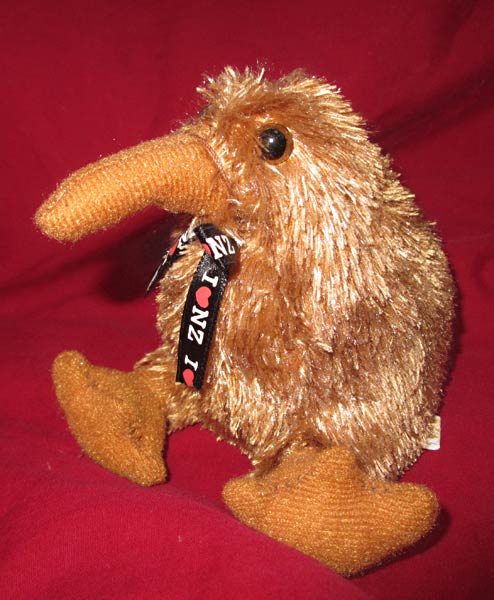
Our new mascot and a valued member of the crew of Legacy.

Passage to New Zealand

November 27 – December 5, 2012
(got tied up around 2am December 6)

It’s ironic that the passage we most feared and dreaded turned out to be the easiest passage of our entire cruise.  The first day was a bit bumpy but it smoothed out after that. The seas were reasonably calm.  The winds were steady and moderate for the most part, occasionally boisterous or occasionally gone completely.  And it stayed mostly warm up to the night we arrived! (Occasionally we’d wear sweat pants instead of shorts and eventually the down comforter was put back on the bed, but that was about it).  There were days out here that were so nice, sailing along on a broad reach in gentle winds, a light swell rolling along from behind us, that I remembered why we have loved some of our passages, and why we had once even considered just taking a trip out to sea for awhile.

Unfortunately, there was a reason we could not just relax and enjoy these languorous days at sea. We hadn’t been out for even 24 hours when Sam, one of the boats in our Pacific Stragglers group, got on the net and reported seeing a low heading for New Zealand that would coincide with our arrival times.  They were now en route to Minerva Reef to wait it out for a few days.

We confirmed this unwelcome news the next morning with our weather sources, including our weather router, Bob McDavitt and Gulf Harbor Radio, a group in New Zealand who do daily weather reports and advice for boats crossing to New Zealand.  They were both advising the same thing: Make it in by the dinnertime on the fifth or wait it out and get in after it passed.  We now had a choice to make: stop at Minerva Reef or try to beat the low to New Zealand.

Minerva Reef (aka Minerva Reefs) is a stopping point for many boats en route to  and from New Zealand. It’s like a sunken atoll in the middle of the ocean. There is no land, but you can walk on the reef at low tide, and you do have to enter it through a pass just like an atoll.  It is really something to experience, and something you can only do by boat.

We had certainly thought about going, but it’s one thing to wistfully think you’d like to go there someday and quite another to actually pack up and provision a boat for a long ocean voyage only to stop a couple of days out, have to anchor, unpack the dinghy and outboard, and use up provisions for the days you are there. It’s like setting out on a long road trip and stopping for the night (or in this case a few nights) just an hour down the road. You just want to keep going for awhile, and with that, we had decided not to stop.  With this news, though, we had to rethink that decision.

In the end, we decided to try to beat the low. Bob McDavitt was able to route us pretty much on a straight line to New Zealand, and if we could keep a 5.6-knot average, we could probably make it in.  At worst, we might get caught in the low, but with winds were predicted to be 20 to 25 knots from the north (gusts to 35), it wouldn’t be anything we couldn’t handle (we might be miserably uncomfortable, but we could handle it).  With this decision, we were committing to going as fast as possible at all times, which meant when those beautiful, gentle winds came along, we needed to turn on the engine to go faster!  That was the theme of our trip: Go faster, faster faster!

At this point, four of the boats in our group opted to head into Minerva Reef, and four of us decided to run for the barn.  Two of the boats were the catamarans already at the front of the pack, and there was pretty much no question they would make it in before the bad weather hit. Sockdolager, a smaller sailboat, would probably have to ride out the low at sea, and Legacy may or may not beat it.

On the Tuesday, the situation became more stressful as we heard the wind might start coming from the west on Thursday.  Bob told us if the winds go west, do not approach New Zealand!  Well, if the winds went west we’d be right into them and could probably not approach New Zealand if we tired! We’d have to hove to.  If we could keep our speed up we could make it in overnight Wednesday.  We’d just have to take things as they came.

By Tuesday night we were hitting the low, but the good news was it wasn’t that bad and the winds stayed from the Northeast, 17 to 22 knots.  We’d get squalls and it would get boisterous and rolly, then it would calm down.  It was the same on Wednesday, boisterous and wet, but the wind speed and direction stayed the same.  We felt a bit silly having to turn on our engine in 20-knot winds, but we had a slight current against us and needed to keep going as fast as we possibly could.

As it turned out, we were able to keep up our speed and entered the Bay of Islands area, New Zealand, very late Wednesday night.  The winds actually lightened to 11 knots as we neared land, but the sky remained very cloudy. We had gone from looking outside every 10 minutes to a full-time watch outside as we approached the Bay of Islands.  For the first time, we were cold, but never quite enough drag out the hats and shoes.  We were exhausted but thrilled to have made it in before the the weather worsened and the winds became westerly (now due to happen the Thursday morning). -Cyndi

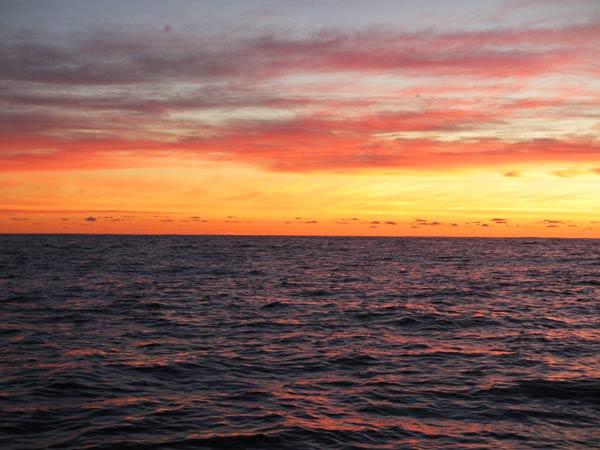
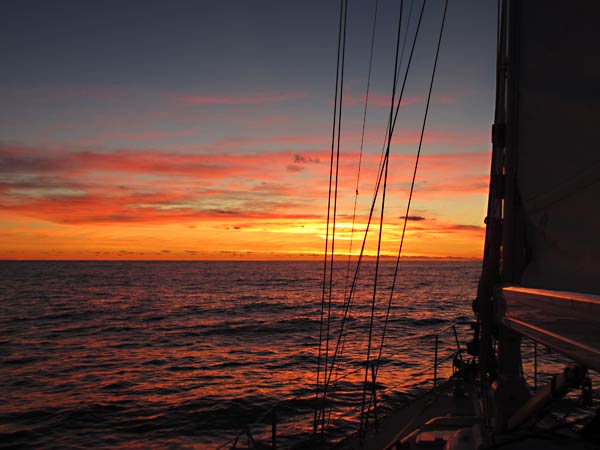
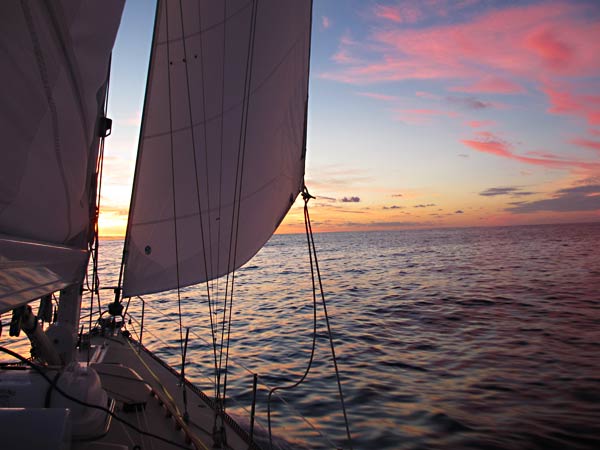
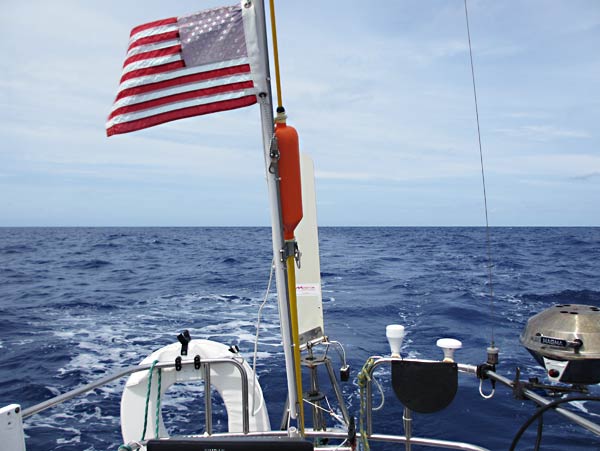
Here are some pictures from the passage…

passage-1

passage-2

passage-4

passage-5

passage-6

The Tropical South Pacific Cruising Awards!

(May – November, 2012)

Before I get on with the passage to New Zealand, I wanted to wrap up the tropical South Pacific topic by giving out the awards. Judges include Rich and Cyndi, who cast their votes over a bottle of champagne in spectacular Rere Bay, Whangaroa, New Zealand. Without further ado, here they are:

Most Beautiful Places:
*Pearl Ridge in Atuona. (Hiva Oa, Marquesas) (link)
*Bay of Virgins, Fatu Hiva (Marquesas) (link)
*The hike to Vaipo waterfall in Daniel’s Bay (Nuku Hiva, Marquesas) (link1 link2 link3 link4 link5)
*The motus in shallow water in the Southwest corner in the Fakarava lagoon. (Tuamotus) (link1 link2)
*Cooks Bay and Opunohu Bay (a tie between the two) in Moorea (Society Islands) (link1 link2 link3 link4 link5)
*The Coral Gardens area by the Le Taha’a Resort (Taha’a, Society Islands) (link1 link2 link3)
*The Motu Tofari area and view towards the east side of Bora Bora (Society Islands) (link)
*Euaiki Island in the Vava’u group (Tonga) (link)

Favorite Places:
*The Southwest corner of Fakarava (Tuamotus) (link1 link2)
*Moorea (Society Islands) (See Moorea section of blog posts)

Least Favorite Places:
*Baie d’Hakahau, Ua Pou (Marquesas): It was beautiful but it had a strange energy, not very good food, seeming underlying hostility towards the boaters, hot, a particularly annoying person trying to visit all the boats, and overall just not a pleasant place to be. (Cyndi) (link)
*Apia (Western Samoa): hot, mosquitoes, obnoxious sales types. (Rich) (Link)

The Most Strangely Exotic Place: American Samoa—the look of it, the seafood buffet, everything! (link1 link2 link3 link4 link5 link6 link7)

Places We’d Most Like To Cruise Again:
*South Fakarava (Tuamotus)
*Tahiti (Society Islands)
*Moorea (Society Islands)
*Bora Bora (Society Islands)
*Fakarava (Tuamotus).

Best Sunrises: Fakarava (Tuamotus) (link)
Best Sunsets: Bora Bora (Society Islands) (link)

Most Fabulous (big bucks) Resorts:
*All the resorts in Bora Bora (Society Islands)
*Le Taha’a Resort in Taha’a (Society Islands)

Most Fabulous Little Hotels:
*Pearl Ridge (Hiva Oa, Marquesas) (link)
*White Sand Beach Resort (Fakarava, Tuamotus) (link)
*The Seabreeze Resort (Western Samoa) (link)
*Moana O Sina (American Samoa) (link)
*The Tongan Beach Resort (Vava’u, Tonga) (link)

Best Place to Chill Out and Live Awhile: The town of Neiafu in Vava’u (Tonga) (link)

Biggest Surprises:
*How much we enjoyed swimming with the stingrays in Moorea (link)
*Having an excellent clambake at the Tradewinds Hotel in American Samoa (link)

Biggest Disappointment:
*That a French society can have such crappy coffee as they do in French Polynesia.

Most Beautiful Water:
*Moorea (Society Islands) (link)
*Bora Bora (Society Islands) (link)
*Fakarava (Tuamotus). (link1 link2)

Best Snorkeling: Tonga.  Best Snorkeling in Tonga:
*The Coral Wonder (Vava’u, Tonga) (link1 link2)
*The Coral Gardens (Vava’u, Tonga) (link)

Best Restaurants:
*#1 Paddles Restaurant (Apia, Western Samoa) (link)
*#2 Le St James (Bora Bora, Society Islands) (link)
*#3 Restaurant Tahaa Maitai (Haamene, Taha’a) (link1 link2)

Best Pizza: *Allo Pizza in Cooks Bay, Moorea (Society Islands) (link)

Best Drink: *The Rum Punch at the White Sand Beach Resort (Fakarava, Tuamtous) (link)

Best Dessert: *Cafe or Chocolate Liegeois at Le St James restaurant (Bora Bora, Society Islands) (link)

Favorite South Pacific Foods:
*Poisson Cru (aka Ota Ika in Tonga and Oka in Samoa) (South Pacific)
(fish marinated with lime and coconut milk with chopped peppers, onion, and cucumber) (link)
*Mahi with vanilla sauce (a French Polynesian specialty) (link1 link2)
*Liegeois (French Polynesia) (top-quality coffee or chocolate ice cream with espresso poured over and whipped cream)
*Palusami (Samoa) (young taro leaves baked in coconut cream—much like creamed spinach)
*Pamplemousse (a large tropical grapefruit)

Weird but Yummy: *Chow Mein sandwiches in Raiatea

Best Moments:
*Drinking Wine on Uoleva Beach (Ha’apai, Tonga) (link)
*Discovering we had a surprise extra day in American Samoa (link)

Biggest Moments:
*Arriving at Hiva Oa island (Marquesas) after crossing the ocean from California (link1 link2)
*Swimming with whales in Tonga (link1 link2)
*Getting an air tour over Samoa on our flight to American Samoa (link)
*Arriving in Bay of Virgins, Fatu Hiva (Marquesas) (link)

Most Fun Moments:
*Our evening with good friends at La Paella Spanish Restaurant on Tapana Island (Tonga) (link)
*Swimming with the stingrays in Moorea. (link1 link2)

Worst Moment: *Getting hit by a succession of waves as we went close a sea mount during the rough passage to Samoa: water in the boat, things flying all over, lots and lots of messes to clean up on a pitching, rolling boat. No fun . . . no fun at all. (link)

Scariest Moment: *After determining the pass out of Fakarava (Tuamotus) was too rough that morning, we turned around only to realize we had gotten too close to it and, backwards or forwards, we were going to be pulled through. Having then to turn around and ride through it like a raft on a white-water rafting trip. (link)

Creepiest Moment: *Getting caught in a weird “Bermuda Triangle” squall between Rangiroa and Papeete which got us in its clutches and started pulling us with it, making us fight to get out. The whole night was weird and creepy. (link)

Most Surreal Moment: *Leaving Vava’u, Tonga at dusk and having a white owl fly over us. (link)

Nicest Culture: *American Samoans.

Least Nice Culture:
*Samoa: It’s not that they weren’t perfectly nice people; they were! But so many people were so relentless about trying to sell us goods and services or otherwise squeezing us for money that it almost became adversarial. (One guy was so bad we dubbed him our “stalker.”)
*The Ha’apai Island Group in Tonga. The Tongan people overall were very nice, but the people of Pengai (the main city there) were not friendly.